

Why we need the children's emergency fund
Around the world, conflict, climate emergencies, hunger and displacement are putting millions of children at risk. Their homes, their education and their lives, are under threat. Whatever the crisis, children are always the most vulnerable.
But children are also extremely resilient. With the right support, they can overcome even the most unimaginable challenges.
Every child deserves to be safe, to learn, to grow, to play. With your support, we can protect children, deliver lifesaving aid, and ensure they have a future filled with hope.
Donate to the Children’s Emergency Fund today to protect children in crisis and help create a world where every child can grow up safe, healthy and be treated fairly. Your support is needed now more than ever.

Save the Children provides an immediate lifeline to conflict-displaced families in Sudan by operating mobile medical clinics and fixed health facilities. Anwar Hamid/ Save the Children
What Is our Children’s Emergency fund?
Our Children’s Emergency Fund is the backbone of our emergency work. It’s a pot of reserves that allows us to act before, during and after an emergency. Donating to the Children’s Emergency Fund is the fastest, most strategic and impactful way to support children in crisis – from sudden disasters to protracted crises or preparing for future shocks.
Here’s why:
- Speed saves lives. We can release funds the moment a crisis hits, so we never have to wait to reach children when every second counts
- Its’ flexibility means our teams can use the money wherever and however it will have the greatest impact for children, adapting to changing needs in the most unpredictable contexts
- It funds the under-reported emergencies as well as the high-profile ones, so children’s lives aren’t waged against global headlines or political agendas
- It bridges critical funding gaps at a time when resources are more strained than ever
- Early action saves lives. It helps communities anticipate and mitigate the impacts of predictable disasters and builds resilience against future shocks, protecting children before emergencies escalate.
How we help children in emergencies
Save the Children has over 100 years of experience responding to crises.
Every day, in the world’s toughest places, we stand side by side with children to protect their rights, support their recovery, and help them build brighter futures.
Here’s how we help:
- Screening and treatment for children with malnutrition, including the provision of ready‑to‑use therapeutic food
- Rapid response to disease outbreaks such as cholera, Ebola, mpox and measles
- Vaccinations and essential primary healthcare services for children and their families
- Primary healthcare and the provision of mobile health teams to give hard to reach communities access to healthcare
- Training for healthcare workers to strengthen local health systems
- Equipping health centres with the supplies and resources they need to treat children, their families and their communities effectively
- Access to education, even in war zones and disaster-affected communities
- Winter kits, hygiene supplies and essentials to help families survive
- Psychological support to help children cope with unimaginable adversity
- Cash grants so families can meet their basic needs and rebuild
- Child protection at the heart of every response, ensuring children aren’t exposed to new risks
- Preparedness and resilience work to reduce the impact of crises before they strike
- Advocacy to protect children’s rights, amplifying their voices when they call for safety and justice
Our approach to emergencies

Be ready
Early warning systems.
Emergency preparedness.
Anticipatory action.

Respond
Local teams and partners.
Global expertise.

Recover
Build community resilience.
Everyday, we continue working to ensure children survive, stay safe and keep learning, no matter what.
In 2025, we responded to 113 emergencies across 63 countries.

A cargo plane carrying 40 metric tones of essential medical supplies lands Port Sudan. Hamid Abdulsalam/Save the children
Find out more about our impact for children
The fund in action
From the tropical storms and floods in southeast Asia to bridging funding gaps in the Democratic Republic of the Congo to reaching earthquake-stricken areas of Afghanistan and Myanmar or Yemen's forgotten crisis, donations to the Children's Emergency Fund ensure children survive, stay safe and keep learning, no matter what.
-
RESPONDING TO TROPICAL STORMS & FLOODS IN SOUTHEAST ASIA
-
Deadly Typhoon Kalmaegi tore through the Philippines and Vietnam at the end of 2025, claiming hundreds of lives and leaving thousands homeless. Before it hit, our teams were already primed, with lifesaving supplies of water, blankets, and hygiene and education kits in place and ready to go.
Just a few weeks later, floods and landslides submerged communities in Thailand, Indonesia and Sri Lanka. Homes were swept away, families were cut off from clean water and healthcare, and tens of thousands of children were left out of school.
Our Emergency Teams, working with local partners, raced to reach the most remote villages with food, clean water, toiletries and other essential supplies. We set up Child Friendly Spaces to support children’s recovery, reunited separated families, and prioritised getting children back to learning, cleaning and repairing damaged schools and distributing back-to-school kits.
-
BRIDGING FUNDING GAPS IN THE DEMOCRATIC REPUBLIC OF CONGO
-
Charly*, a mother of seven, fled her home from conflict in North Kivu. Her youngest daughter, 15-month-old Gervienne*, became severely malnourished — weak from, diarrhoea, vomiting and a high fever. Charly* rushed her to the hospital, where Save the Children provided lifesaving treatment, including Plumpy’Nut, to help her recover. Now, Charly* dreams of a safer, more secure future where all her children can grow up healthy, educated, and free from hunger.
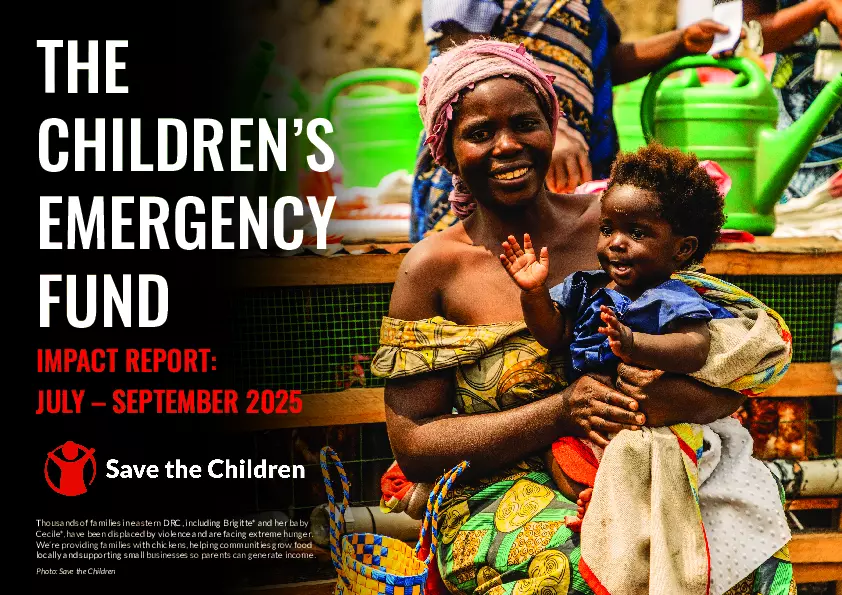
Children in the DRC face one of the world’s largest humanitarian crises. One in every four people need urgent support due to violent conflict, climate shocks and disease outbreaks. Fighting has escalated drastically in 2025 to levels not seen in a decade. Despite soaring needs, this crisis remains among the most underfunded globally. Thanks to the Children’s Emergency Fund, we’ve released over $2 million to protect children caught in this relentless crisis.
-
REACHING EARTHQUAKE-STRICKEN AREAS OF AFGHANISTAN AND MYANMAR
-
In March 2025, a 7.7 magnitude earthquake struck central Myanmar, causing mass devastation in a country already struggling with conflict and climate-related disasters. Within hours, the Children’s Emergency Fund released funds, enabling our local teams and partners to provide food, water, hygiene supplies, emergency healthcare and psychological support. Within days, more than 10,000 people had received help.
Months later, an enormous 6.0 magnitude earthquake struck eastern Afghanistan. Over 2,000 people were killed and more than 14,000 homes destroyed or damaged across four mountainous provinces. Again, the Children’s Emergency Fund enabled an immediate response. Our mobile health teams trekked into the worst affected areas to provide emergency healthcare, clean water, sanitation and child protection services. We created safe spaces for children and delivered cash, blankets and shelter kits to families who had lost everything.
-
YEMEN’S FORGOTTEN CRISIS
-
Children in Yemen are enduring one of the world’s worst humanitarian crises after over a decade of war, coupled with a declining economy and climate shocks. Around 60% of the population needs urgent support, and more than half are children. Through the Children’s Emergency Fund, we’ve responded to catastrophic flooding, disease outbreaks and widespread health system disruptions in the past year alone.
Eight month old Murad* from Taiz became severely malnourished as conflict and economic pressures left his family struggling to access food and clean water. Without treatment, his condition could have been fatal. Thankfully, he was referred to a Save the Children-supported health centre, where he received the urgent medical care he needed.


Looking ahead
In the past year, we’ve seen major cuts to foreign aid budgets by governments around the world, even as global instability deepens. Humanitarian need is rising, while the resources available to meet it are shrinking. In that context, our work, and how we do it, is more vital than ever.
In 2026, Save the Children will keep children at the heart of every response. We’ll advocate for their rights and ensure their voices are heard.

Nazek*, 30, is a mother of four from Gaza, including her youngest daughter, Nour*, who is just over a year old. With little food available during her pregnancy, Nazek* became malnourished, and by seven months old, Nour* was diagnosed with Severe Acute Malnutrition (SAM). With support from Save the Children’s nutrition clinic, Nour* has improved but remains fragile, often surviving only on supplementary therapeutic food. Like thousands of families across Gaza, they face the daily reality of famine, malnutrition, and an uncertain future. Eyad AlTawil / Save the Children
