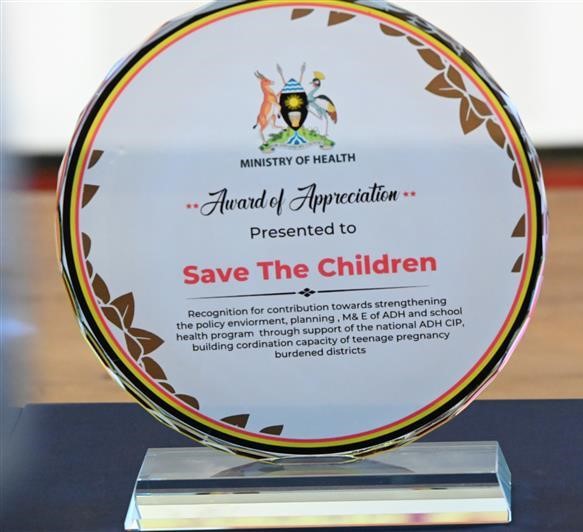
Save the Children Uganda was recognized and appreciated by the Ministry of Health and the Committee of Experts on the National Safe Motherhood Committee for its outstanding contribution to strengthening the policy environment, planning, and monitoring and evaluation of Adolescent Health and School Health programmes. This recognition further highlighted our role in supporting the implementation of the National Adolescent Health Costed Implementation Plan (ADH CIP) and in building the coordination capacity of districts heavily burdened by teenage pregnancy.
Save the Children Uganda was recognized and appreciated by the Ministry of Health and the Committee of Experts on the National Safe Motherhood Committee for its outstanding contribution to strengthening the policy environment, planning, and monitoring and evaluation of Adolescent Health and School Health programmes. This recognition further highlighted our role in supporting the implementation of the National Adolescent Health Costed Implementation Plan (ADH CIP) and in building the coordination capacity of districts heavily burdened by teenage pregnancy.
In addition to policy-level contributions, Save the Children was honored with a Certificate of Recognition for its impactful work in improving maternal and newborn health across the Kampala Metropolitan Area. This achievement reflects our leadership in driving innovation, strengthening health systems, and advancing equitable access to lifesaving services for mothers, newborns, and adolescents.
At the forefront of this work is the Saving Women and Preterm Babies (SWAP) project, which continues to transform care in underserved and remote settings. By introducing low-cost, context-appropriate technologies such as the VAYU Bubble CPAP which is an electricity-free device that has significantly expanded access to respiratory support for preterm babies and deploying digital tools like PRISMS (Protecting Infants Remotely through SMS) for real-time maternal and newborn outcome tracking, Save the Children is enabling health workers to make faster, more informed decisions.
Our Sexual and Reproductive Health and Rights (SRHR) programming further contributes to national efforts to reduce teenage pregnancy. Through age-appropriate SRHR information, menstrual hygiene management support, and close collaboration with the Ministry of Health and partners, we have advanced key guidelines and strengthened adolescent and school health interventions.
Our nutrition work integrates both nutrition-specific and nutrition-sensitive approaches across development and humanitarian contexts, ensuring inclusive, equitable service delivery including for persons with disabilities through collaboration with districts and Organisations of Persons with Disabilities (OPDs).
During the conference, Save the Children led a high-level panel discussion on newborn care and hosted an exhibition booth showcasing our innovations, evidence, and learning. Delegates expressed strong interest in our approaches, reinforcing our sector leadership.
Key Achievements Celebrated at the Conference:
1,992 babies treated with VAYU bCPAP
Three neonatal units functionalised and two strengthened
Installation of an oxygen manifold system at Kisenyi
80% reduction in referrals
30% reduction in mortality
130 health workers trained in Helping Babies Survive and Helping Mothers Survive
Quality Improvement structures functionalised across all supported facilities
Increased uptake of antenatal corticosteroids for preterm labour management
Successful presentation of project results and leadership of the newborn care panel
Awarded a Certificate of Recognition as a Kampala Metropolitan Area implementation partner
This recognition affirms Save the Children Uganda’s unwavering commitment to ensuring that every mother, newborn, and adolescent has access to the care and support they need. We remain dedicated to scaling proven innovations, strengthening systems, and partnering nationally to advance safe motherhood for all.