
The Karamoja GOATS project, implemented by Save the Children Uganda with funding from Save the Children Korea (SCK), was launched in March 2021 to combat malnutrition and food insecurity in Moroto District. The project focused on supporting agropastoral households, especially women, by providing goats to improve food security and boost livelihoods.
By June 2024, the project had already achieved significant impact in improving nutrition and strengthening household assets. A new phase is now underway, building on these successes and aiming to reach more families by December 2025. The project also works closely with community-based structures such as Male Action Groups, Village Health Teams (VHTs), care groups, and Breed Improvement Committees (BICs) to ensure long-term sustainability.
When Regina, a 36-year-old mother of six from Loboborio Village, Rupa Subcounty, Moroto District, received two gala goats through the Karamoja GOATS project, she never imagined how much they would change her life. Today, she is a community role model, inspiring other women with her success in goat rearing, which has helped improve her family’s nutrition, provide income, and support her children’s education.
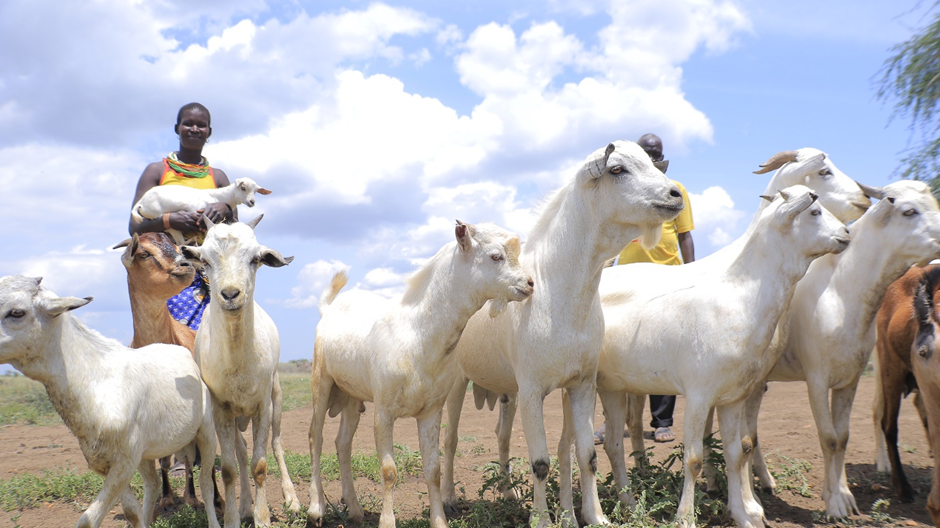
Since receiving her two goats, her herd has grown to 13. She has also passed on two kids to Amei Sarah, a fellow community member in her care group, ensuring that others benefit just as she has.
The goats have played a major role in transforming her family’s well-being. “After passing on, our goats had multiplied to 11 and we sold four of them to pay school fees for my eldest son, Lokong Ignatius, who is now in Senior Three at Moroto High School and take care of other household needs” she says.
For Lokong, an aspiring doctor the goats have meant a chance at a better future. “Because of the goats, I can go to school and will work hard until I become a doctor.”
Apart from school fees, the goats have helped improve nutrition at home. Despite the long dry spell, Regina milks two of her goats daily, collecting about two liters of milk. She uses this milk to make ‘bongo,’ a fermented milk that she adds to porridge for her children. “I also give some to the neighbors’ children,” she adds with a smile. “Because of this, the children from around always come to my home since they know they will find something to eat.”
Regina and her husband, Lokawa Timer, a 57-year-old Community Animal Health Worker (CAHW), are very committed to taking good care of their goats. Tema plays a vital role in keeping them healthy—spraying, deworming, treating them when they fall sick, and ensuring they have proper shelter and food. He also supports other families in the community by providing veterinary care and guidance on goat maintenance.
However, due to the ongoing dry spell since November 2024, pasture has become scarce. To ensure the goats remain well-fed, Timer collects dried acacia pods, which serve as a vital supplementary feed.
Because of her success in goat rearing, Regina’s home has been recognized as a model home in the community. She is preparing to host an exchange visit, where she will welcome Lead Mothers, neighbor women, and Village Health Teams (VHTs) from Pupu, Mogoth, and Lokisilei Parishes. She is currently organizing her home, goat shelter, and kitchen garden in preparation for the visit.
“I intend to tell the visitors how grateful I am to Save the Children and how I have successfully maintained my goats so that they multiply,” she says. “I will also share the benefits I have received from the goats, the most important being keeping my children in school.” Beyond goat rearing, Regina is also the chairperson of Katiangole, a Village Savings and Loan Association (VSLA) group supported by the GOATS project. The savings cycle, which began in January 2025, has so far accumulated 450,000 UGX, with Regina having saved 35,000 UGX. “I borrow money from the group to take care of household needs and boost my brewing business to earn more money and continue saving,” she says.
Like many in Karamoja, Regina’s family is facing challenges due to the prolonged dry spell. The high temperatures have made access to food difficult, and prices have increased significantly. Kitchen and backyard gardening are currently unsustainable, as the soil is too hot to support crops, even with regular watering. To ensure her goats remain healthy despite the harsh conditions, she continues to supplement their diet with dried acacia pods. However, she hopes for additional support to help her sustain and grow her efforts.
“Since my goats have multiplied, I request support in constructing a stronger, raised shelter with an iron sheet roof for them, where they will have enough space to sleep,” she says. “I also request another goat, which I can multiply and later pass on a kid to another beneficiary.”
Regina remains deeply grateful for the support she has received. “Thank you so much, Save the Children Korea, for this project,” she says.
“Through the knowledge I have gained on animal husbandry and good practices, I have been able to improve my life and household. Because of this, my children are healthy and in school.”