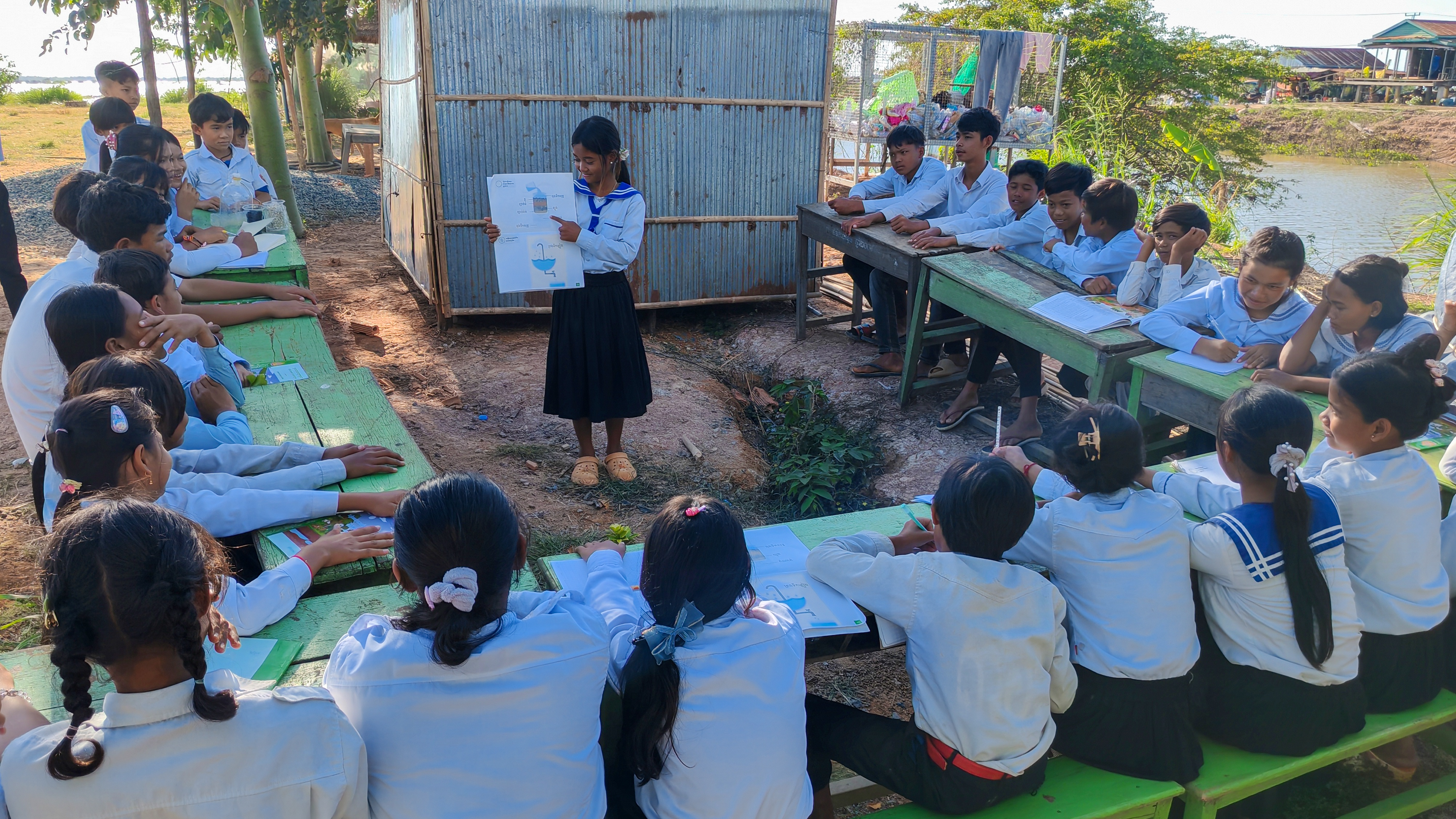
Pisey is an 11-year-old grade 6 student from Kampong Chhnang province. She lives with her parents and two siblings. Her father is a fisherman, and her mother works as a small seller. The family has long struggled financially, often earning only enough for daily food. Despite this, her parents strongly support their three children continuing learning.
In 2020, the family faced a significant challenge when government policy required them to relocate from their floating house to a land plot in Peam Khnorng, about 16 kilometres from the river where they depended on fishing. With skills limited mainly to fishing, adapting to land-based life was very difficult. They had no experience growing rice, vegetables, or raising animals. Through hard work, borrowing money, and encouragement from teachers, they slowly adjusted by starting a small home business, cultivating rice and vegetables, and raising chickens. Over time, their living conditions improved. Due to their financial hardship and good character, teachers and supportive individuals also provided the family with a monthly stipend of 100,000 Riel for two years.
Before 2022, environmental activities at Pisey's school were limited to weekly cleaning, and students had little understanding of biodiversity or environmental issues. This changed when the Save the Children Norway-funded Green Generation (GG) project partnered with the school and introduced six practical environmental lessons. Through these lessons and guidance from her parents and teachers, Pisey learned about environmental problems such as plastic pollution, deforestation, illegal fishing, declining fish stocks, and the misuse of chemical fertilisers. Realising how these issues affected her community and future livelihoods, she became deeply motivated to protect the environment.
Encouraged by her teachers and the GG project, Pisey took on responsibilities as a children's council member and later as a leader. She actively participated in project activities and attended meetings with teachers, the school support committee, and the commune council. She led waste management campaigns, tree planting activities, and other school initiatives. At first, she faced resistance from some older community members who believed children should not advise adults. Despite feeling nervous, Pisey remained committed. She worked closely with supportive adults and continued presenting her ideas at monthly commune council meetings.
One of her most notable activities was a soil erosion experiment comparing bare soil with soil covered by vegetation. Through this experiment, she learned that trees and leaves help prevent erosion and keep water clean, while bare soil leads to runoff and land degradation. She also explored broader community issues, including storms, lightning, and the decline of fish and wildlife. Pisey turned her findings into presentations for classmates, teachers, school exhibitions, and commune-level meetings, helping others better understand environmental protection.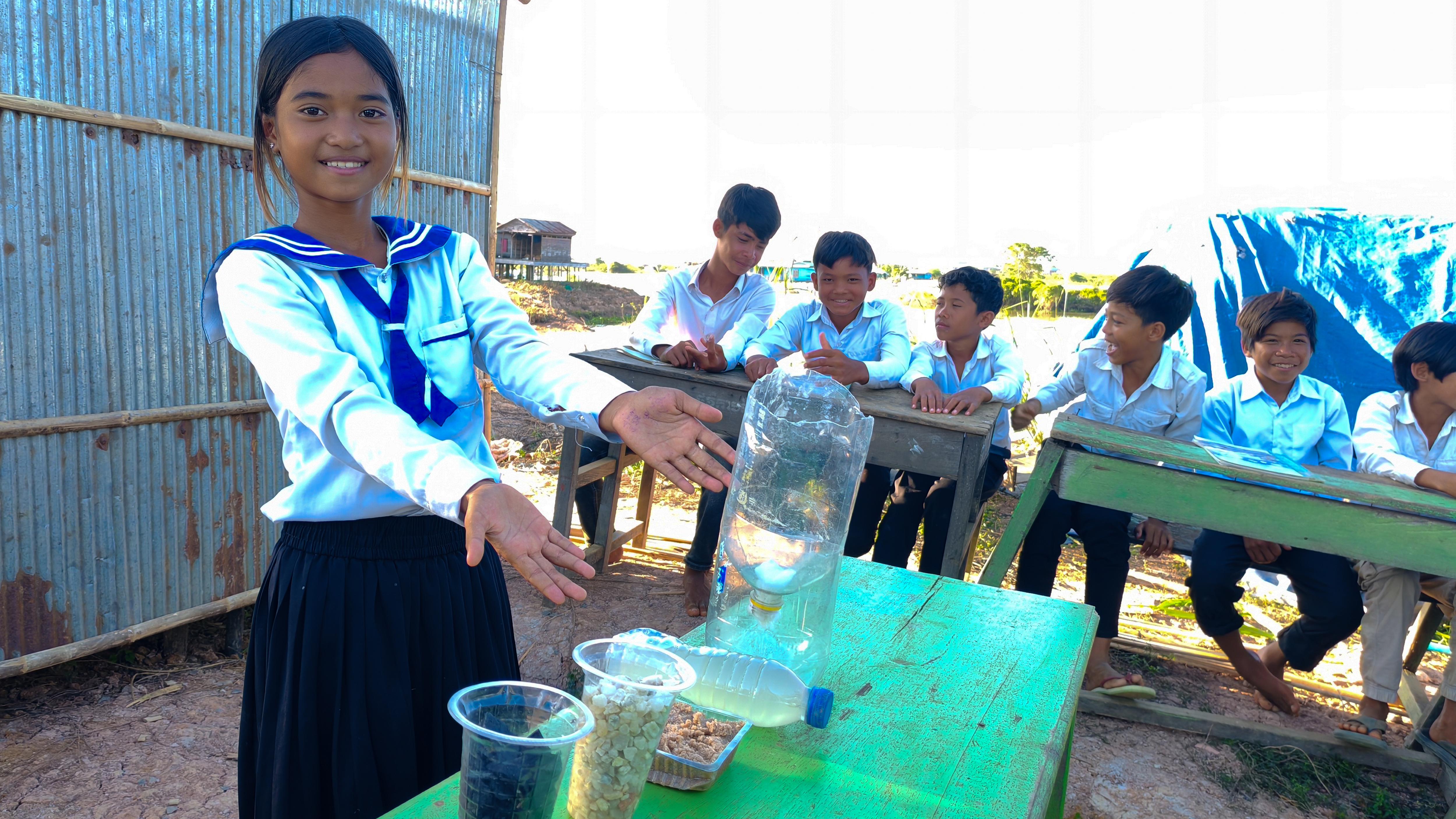
Her consistent efforts and growing confidence led to her election as children's council leader for the 2025–2026 academic year. In this role, she promotes waste management, tree planting, and ensures environmental needs are included in the school's operational plan. Her advocacy reached local government, where the Phlov Touk commune council praised her courage and leadership. As a result, they approved significant funding: 10,500,000 Riel in the 2025 budget for playground repairs, a flagpole, a school gate, solar lighting, and tree planting, and planned budgets for 2026, including 4,000,000 Riel for a waste incinerator and 8,000,000 Riel for a metal-roofed bicycle parking shed.
Through her involvement, Pisey gained strong soft skills such as communication, facilitation, presentation, relationship-building with both children and adults, and emotional resilience. Reflecting on her role, she shared, "For me, this role is not merely a title, but a high responsibility to act as a role model, a coordinator, and a voice representing all children in the school. I promise to do my utmost to make our school a happy place for every child."
Her dedication has been widely recognised. Mrs. Soteang, a member of the commune committee for women and children, stated that "Pisey has the confidence, capacity, and courage to lead environmental activities and represents valuable human resources for the next generation."
Mr. Sitha, Principal of Peam Khnorng Primary School, added: "Pisey is a model student. Despite her family's financial situation, she has developed into a capable leader with strong responsibility and communication skills. I trust she will be an important resource for the community in the future."
Today, Pisey is proud of the positive changes she has helped create, including improved waste management, greener school spaces, and a more attractive learning environment that encourages regular attendance. Confident in speaking up for the common good, she dreams of becoming a teacher in her village. Aware of the shortage of local educators, she hopes to teach both general subjects and environmental knowledge to help build the future of her community. As she says, "I want to lead and teach children here because our community lacks human resources."